
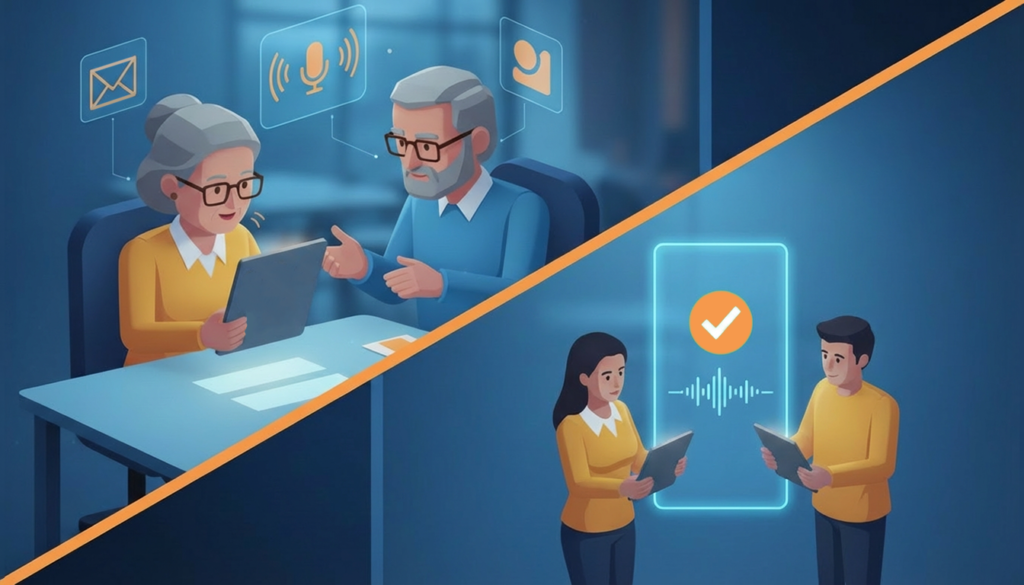
When families question a phone authorization, the concern usually comes from uncertainty rather than the technology itself. Adult children often ask some version of the same question: “What actually happened on that call?” The hesitation comes from not knowing whether there’s anything concrete they can review afterward.
That’s the real objection. People want to know whether the agreement can be clearly verified.
This guide is written for two groups simultaneously. One is operations and compliance leaders who need an authorization process that is defensible and ready for audit. The other is family members who want visibility, clarity, and reassurance, not shortcuts.
We will answer the core question, “Is a voice signature legally binding?”, and then go further. The focus is on translating the law into something families can actually understand through a Family Ready Proof Package built around clear, reviewable evidence.
What Is a Voice Signature, In Plain Language?
A voice signature is a spoken authorization captured during a phone call and preserved as part of the official record. It goes beyond someone simply saying “yes” out loud.
A compliant voice signature includes clear verbal intent to agree, consent to complete the transaction electronically, a recording of the call, supporting details like timestamps and call information, and a stored record that can be reviewed later if questions come up.
What matters is not the voice on its own but the evidence trail created around that moment.
What Does “Legally Binding” Actually Mean?
When something is described as legally binding, it doesn’t mean it can never be challenged. It means the agreement meets a few basic requirements. There must be a clear offer and acceptance, intent to agree, consent to the method used, and evidence that the agreement actually took place.
In practice, courts focus less on how something was signed and more on whether the agreement can be shown to have happened. If that proof is clear and credible, the form of the signature matters far less.
That focus on proof is where well-designed voice signature processes can outperform simple click-through e-signature flows.

The Core Legal Foundation: Electronic Signatures Are Valid
Under U.S. law, a contract cannot be denied legal effect solely because it’s electronic. That principle is established by the Electronic Signatures in Global and National Commerce Act (E-SIGN).
At the state level, most jurisdictions follow the Uniform Electronic Transactions Act (UETA), which defines an electronic signature as a sound, symbol, or process associated with a record and executed with the intent to sign. By that definition, a voice can qualify as an electronic signature.
Legality alone does not guarantee enforceability. Whether a voice signature can hold up in court depends on how well the process captures, preserves, and links the evidence of consent.
The Four Building Blocks of Enforceability
Every defensible voice signature relies on four key pillars. Miss one, and families or auditors will start asking questions.
1. Intent to sign
The signer must clearly express that they are agreeing, not just acknowledging information. A best practice is to capture intent in the signer’s own words, using plain language such as: “Yes, I agree to the terms we discussed.”
Ambiguity is the enemy here. Families trust clarity.
2. Consent to do business electronically
The signer must agree to use an electronic method instead of paper. This is more than a technicality; it is a legal requirement under E-SIGN. A simple way to capture this consent is to ask explicitly and record the response: “Do you agree to complete this authorization electronically and have it recorded?”
That single sentence does a lot of legal work.
3. Attribution (connecting the act to the person)
Attribution answers the question: who actually gave consent?
Voice systems don’t need to guarantee identity perfectly. They need to show a reasonable link between the signer and the action, using details like call information, account context, agent logs, and timestamps. Families don’t need perfection; they need confidence that the right person approved the transaction.
4. Record integrity
This is where trust is established. A valid process preserves:
- Timestamps
- Call recordings
- Transcripts
- Retention policies
- Tamper-evident storage
The goal is to create a record that can be reviewed and verified at any time.
Why “Paper Trail” Is a Mindset, Not a Medium
When families say, “I just want a paper trail,” what they really want is a clear, trustworthy record.
Paper can be misplaced, PDFs can be altered, and login-based e-signatures often provide little human context. A well-designed voice signature offers something stronger. It creates a narrated record that shows exactly what was explained, what was agreed to, and when, so anyone reviewing it later can understand the full context with confidence.
Introducing the Family-Ready Proof Package
If you want to reduce family pushback, the focus should be on showing proof, not defending the method. A Family-Ready Proof Package includes four key components:
1. The recording
The audio captures tone, pacing, and clarity. Families can hear that the signer wasn’t rushed or confused. It shows that the conversation happened, disclosures were made, and consent was verbalized. On its own, however, the recording doesn’t provide the full legal context without supporting records.
2. The transcript
Transcripts reduce ambiguity by making spoken consent readable, searchable, and easy to review. For family members, this is often the most reassuring part of the record.
3. Timestamps and metadata
These details answer practical questions: when did the consent occur, how long did the call last, and who was present? These pieces of information often become crucial if the authorization is ever questioned later.
4. A plain-English summary
A short, plain-English summary explains what was authorized, how consent was captured, where supporting records are stored, and how long those records will be retained. Providing this upfront creates real transparency and prevents conversations from feeling defensive when proof is requested.
How to Share Documentation Without Friction
Organizations don’t need to overwhelm families with raw data. The goal is to provide access in ways that are simple, clear, and reassuring. Some practical options include using secure portals with view-only access, providing PDF summaries linked to recordings, offering transcripts on request, and giving clear information upfront about how long records will be retained.
When families can see what’s available and understand how to access it, trust grows. Leaving them in the dark only creates doubt and frustration.
Common Trust Breakers To Avoid
When families push back, certain red flags often signal the problem. These include vague disclosures during the call, missing transcripts, unclear retention policies, explanations that rely on “trust us” instead of showing proof, or a lack of a plain-English summary for non-experts.
It’s important to remember that none of these issues is necessarily a legal failure. They are communication failures. Clear, transparent documentation is what earns confidence and prevents questions from escalating.
How To Explain Voice Signatures To Family Members
When you need to reassure family members, it helps to have a simple, clear explanation you can read or paraphrase. You might say:
“We capture authorization during a recorded call where the terms are read aloud. Your family member gives clear verbal consent, agrees to complete the process electronically, and approval is preserved with a recording, transcript, and timestamps. Nothing is finalized without that documented consent, and those records are available for review at any time.”
Saying it this way calmly and clearly puts you ahead of most systems.
Internal Alignment: What Ops and Compliance Should Agree On
Before rolling out voice authorization at scale, teams should align on the essentials. This includes the disclosure language that must be read on every call, minimum standards for recording quality and completeness, whether and how transcripts will be created and shared, how long records will be retained, and what options exist for giving authorized family members access to review documentation.
When these expectations are clear from the start, implementation runs more smoothly, and last-minute scrambling is minimized when questions, audits, or objections inevitably arise.
Closing Checklist: Reduce Pushback By Showing Proof
If your process clearly demonstrates the following, you’ll earn confidence rather than skepticism:
- ✔ Clear spoken intent
- ✔ Explicit electronic consent
- ✔ Attribution context
- ✔ Recording + transcript
- ✔ Timestamps + retention clarity
When these elements are in place, you are protecting families and building trust.
The standard that truly matters
So, is a voice signature legally binding? Yes, when it is built on clear intent, explicit consent, proper attribution, and a record that can be reviewed.
Legality is only the starting point. Trust comes from allowing families to see what happened, hear what was said, and understand exactly how consent was captured.
If your current process cannot provide that level of transparency, consider a simple question: would a family member feel confident reviewing this record six months from now?
That is the standard that truly matters.
If you want to make sure your voice authorization process is both legally sound and trusted by families, Contract Pal can help.
Our platform provides a clear, reviewable record for every authorization, giving you the confidence that consent is captured correctly and transparently. Book a call with Contract Pal to see how it works and get started.